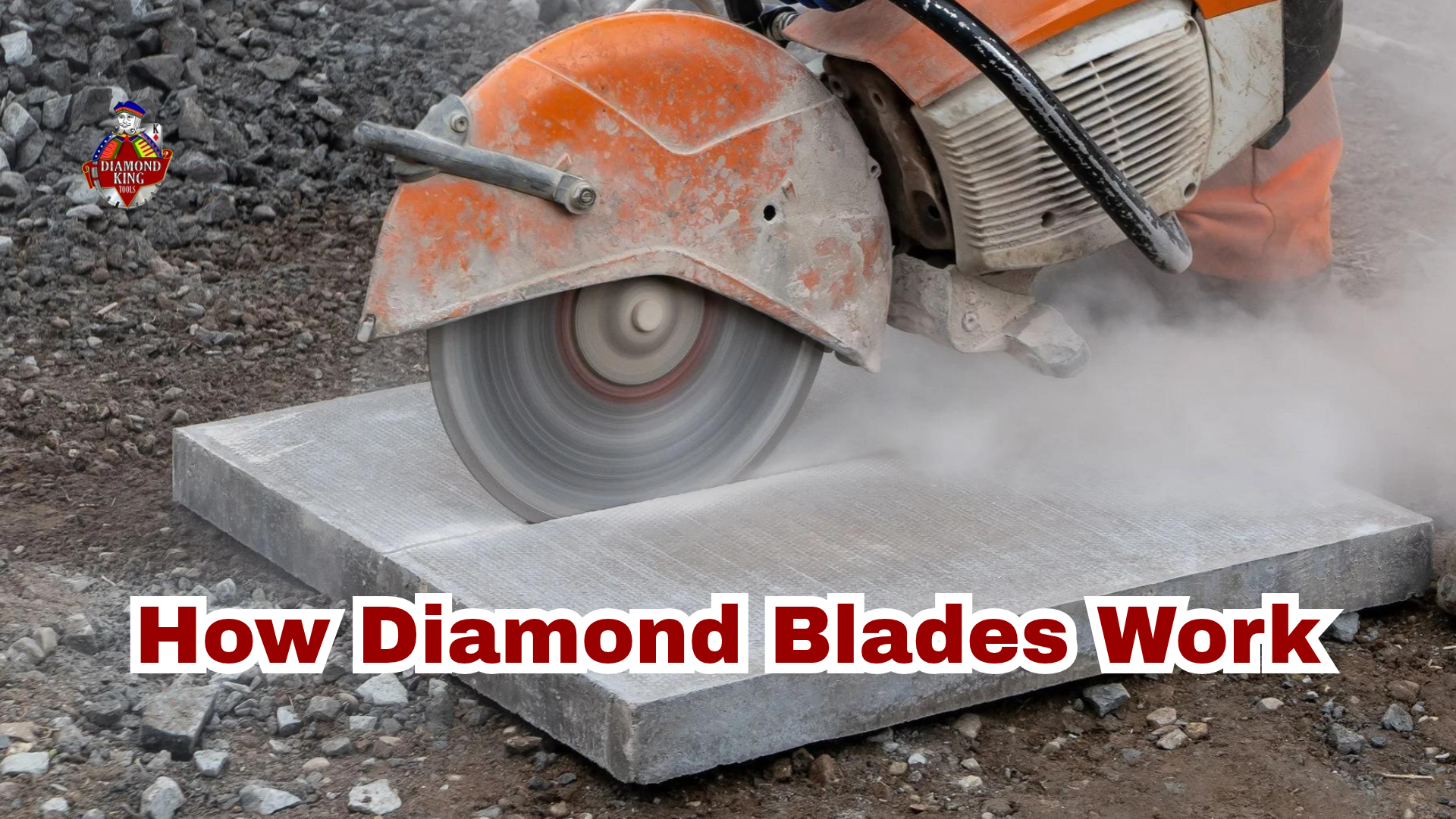
Diamond blades are used every day by concrete contractors, masons, hardscaping professionals, and construction crews. They are designed to cut through tough materials such as concrete, asphalt, brick, block, stone, and pavers. But have you ever wondered “how do diamond blades work?”
Unlike a traditional saw blade with sharp teeth, a diamond blade uses industrial diamond particles to grind through hard materials. These diamond particles are held in place by a metal bond that gradually wears away during cutting, exposing fresh diamonds underneath.
This continuous process allows the blade to maintain its cutting ability throughout its service life.
Understanding how diamond blades work can help you choose the right blade, improve cutting performance, and get more life out of your investment.
What Is a Diamond Blade Made Of?
Before understanding how a diamond blade cuts, it helps to know what makes one up.
A typical diamond blade has two main components: a steel core and a diamond cutting edge.
1. Steel Core
The steel core is the circular metal center of the blade. It provides structural support and helps the blade maintain its shape while rotating at high speeds.
Depending on the blade design, the core may include slots called gullets. These spaces help with cooling and allow water or air to move through the blade during operation.
The core also has a center opening called the arbor hole. This is where the blade attaches to the saw.
2. Diamond Segments
The diamond segments are located around the outside edge of the blade. They contain industrial-grade synthetic diamond particles mixed with metal powders.
These segments are responsible for the actual grinding action that allows the blade to cut through hard materials.
The diamonds are held in place by a metal bond, also called a matrix. The bond controls how quickly the segment wears and exposes new diamond particles.
How Do Diamond Blades Actually Cut?
One of the biggest misconceptions about diamond blades is that they cut like traditional saw blades.
Diamond blades don’t actually slice through material. They grind it away.
Here’s how the process works:
- The blade rotates: The saw spins the diamond blade at its specified operating speed.
- Diamonds contact the material: Exposed diamond particles on the cutting edge make contact with the surface.
- The diamonds grind the material: The hard diamond particles abrade the material, breaking it down into fine particles.
- The diamonds gradually wear: As cutting continues, the exposed diamonds become dull, fracture, or break away.
- The metal bond wears down: The surrounding metal matrix gradually erodes, releasing worn diamonds and exposing fresh ones underneath.
This process repeats continuously as the blade cuts.
The combination of diamond wear and controlled metal bond wear is what allows a diamond blade to keep cutting effectively.
What Is the Metal Bond in a Diamond Blade?
The metal bond is one of the most important parts of a diamond blade.
It holds the diamond particles in place and controls how quickly they become exposed during cutting.
Different materials wear down the metal bond at different rates. This is why manufacturers create blades with different bond hardnesses.
The general rule is:
- Soft bond: Best suited to hard, dense materials that do not wear away the bond easily.
- Medium bond: Used for suitable general-purpose applications.
- Hard bond: Best suited to soft, abrasive materials that would wear away a softer bond too quickly.
For example, hard concrete often requires a softer bond so worn diamonds can be released and fresh diamonds exposed. Asphalt is softer but highly abrasive, so a harder bond helps resist rapid segment wear.
Choosing the correct bond helps balance cutting speed and blade life.
What Are the Different Types of Diamond Blades?
Not all diamond blades have the same cutting edge. Different designs are made for different materials and applications.
Segmented Diamond Blades
Segmented diamond blades have individual cutting sections separated by open spaces called gullets.
These spaces help with cooling and debris removal during cutting.
Segmented blades are commonly used for:
- Concrete
- Brick
- Block
- Masonry
- General construction applications
They are a popular choice for contractors who need a blade for demanding cutting jobs.
Continuous Rim Diamond Blades
Continuous rim blades have a solid, uninterrupted cutting edge.
They are commonly used when a cleaner finish is important, such as cutting ceramic tile, porcelain, and certain stone materials.
These blades are often used with water to help control heat and reduce chipping, depending on the blade’s specifications.
Turbo Diamond Blades
Turbo blades have a serrated or ridged cutting edge.
Their design combines features of segmented and continuous-rim blades. They are often used when contractors want a balance of cutting speed and finish quality.
Turbo blades are available for different materials, so always check the manufacturer’s application recommendations.
Why Is Choosing the Right Diamond Blade Important?
Using the correct diamond blade can make a major difference in cutting performance.
A blade designed for the wrong material may cut slowly, wear prematurely, or become glazed.
For example, a blade with a bond that is too hard for dense concrete may struggle to expose fresh diamonds. A blade with a bond that is too soft for abrasive asphalt may wear down too quickly.
Before choosing a blade, consider:
- The material you need to cut.
- The hardness and abrasiveness of the material.
- The saw you are using.
- The blade diameter and arbor size.
- The required cutting depth.
- The blade’s maximum RPM.
- Whether wet or dry cutting is appropriate.
Matching the blade to the material and equipment helps you get better performance and value.
How Long Do Diamond Blades Last?
There is no single answer because diamond blade life depends on several factors.
These include the material being cut, blade quality, bond formulation, cutting depth, operating speed, equipment horsepower, and cutting technique.
Water supply also matters when using a wet-cutting blade. Proper water flow helps control heat and remove cutting debris.
Using the wrong blade or applying excessive pressure can also shorten blade life.
To get the most out of your diamond blade:
- Choose a blade designed for your material.
- Follow the recommended RPM.
- Use the correct wet or dry cutting method.
- Avoid forcing the blade through the material.
- Inspect the blade regularly for damage and wear.
- Follow the manufacturer’s operating instructions.
How Do You Know When a Diamond Blade Needs Replacing?
Diamond blades gradually wear down as the segments are used.
You should inspect your blade regularly and look for signs such as:
- Excessive segment wear.
- Missing or damaged segments.
- Visible cracks or damage to the steel core.
- Unusual vibration.
- Poor cutting performance.
A blade that cuts slowly may also be glazed or improperly matched to the material. However, do not assume that every performance issue can be fixed by dressing the blade.
If the blade is damaged, has missing segments, or has reached its wear limit, stop using it and replace it according to the manufacturer’s instructions.
Never operate a damaged diamond blade.
Get More From Your Diamond Blades
Understanding how diamond blades work is an important part of choosing the right cutting tool for your job.
The industrial diamonds do the grinding, while the metal bond holds them in place and gradually wears away to expose fresh cutting particles. The steel core provides the support needed for the blade to operate.
When you combine the correct blade design, bond hardness, and cutting application, you can improve cutting performance and make better use of your equipment.
At Diamond King Tools, we offer diamond blades designed for a variety of professional cutting applications, including concrete, asphalt, brick, block, stone, and pavers.
Have questions about choosing the right diamond blade? Reach out to Diamond King Tools. Our team can help you find the right blade for your equipment and application.